- Seeds of Change Consulting Newsletter
- Posts
- On Not Adjusting | May 2026


"It is no measure of health to be well adjusted to a profoundly sick society."
Friends,
We want to spend some time with Krishnamurti this month, because his words describe something we see again and again in the work of mothering.
We mean mothering as a verb. An action. The labor of caring for what is vulnerable and helping it grow. Anyone can do this. People mother children, partners, communities, projects, even the parts of themselves no one cared for the first time.
When the System Is the Problem
A person doing this labor can't sleep. They are rageful, exhausted, depleted. Doctors, partners, books, and their own inner voice all suggest something is wrong with them.
What if nothing is wrong with them?
What if the body is responding accurately to a culture that expects caregiving to happen alone, without rest, without backup, while staying productive and patient about it? The exhaustion may not be a personal failing. It may be an honest read on impossible terms.
Krishnamurti refuses the diagnosis we so often hand to caregivers: adjust. Adjust to less support and more demand. Adjust to a culture that romanticizes the work while abandoning the workers. Be well, here, in this. He says that's no measure of health.

Some mothering is itself a quiet refusal. A daily insistence that something else is possible. A person sets a boundary their own caregivers could not. They sit with another person's tears without rushing to fix them. They stop apologizing for their own hunger, rest, or no.

This rarely makes the news. But it changes what gets passed down. Each generation inherits patterns of self-abandonment, silence, chronic vigilance held in the body. Not passing them on is a way of refusing to be well-adjusted to what was. The sickness stops moving through you.


May is also AAPI Heritage Month. The work of mothering as refusal runs through Asian American and Pacific Islander traditions too, often without being named that way.
Yuri Kochiyama raised six children in Harlem while organizing alongside Malcolm X and the Black Power movement. Her apartment was an open house for activists across Black, Asian, and Puerto Rican struggles. She was beside Malcolm at the Audubon Ballroom and cradled his head as he was dying. Her mothering and her organizing were never separate things. Grace Lee Boggs spent more than sixty years in Detroit doing similar work, treating the city and its young people as things that needed tending.
Both women refused the role American culture has long pressed on AAPI communities. Be quiet. Be productive. Do not name the harm. The model minority myth is, at its core, a demand to be well-adjusted to a sick society.
 Grace Lee Boggs |  Yuri Kochiyama |

People will keep trying to grow inside conditions that can't support them. That's what makes mothering both extraordinary and heartbreaking.
Our work at Seeds of Change has always been about something more honest than asking the individual to try harder. We work on the conditions themselves. The structures, the cultures, the supports that decide whether someone can flourish or only survive.
Adjustment isn't the same as healing. A person struggling inside a system designed to exhaust them isn't broken. They are seeing it clearly. The path forward isn't to make them better at being depleted. It's to question the depletion.


If you are mothering anything this month, here's a question to carry:
Where am I working hard to adjust to something that's asking too much?
Sit with it. The answer might be uncomfortable. Health doesn't always look like coping better. Sometimes it looks like refusing to.
We'll leave you with a poem that has been sitting with us this season.
Gift
Years from now
I hope to be
a tree
who has gathered seasons
of light and given
just as much
comfort to those around me
May these roots
feed the earth
my branches carry fire
please take this trunk
and build your home
and catch my leaves with children
Know that I
am forever yours
and We
are the gift
I've lived for
— digger
This is the work Seeds of Change does, and it is mothering work in the sense we have been using. The labor of tending what is vulnerable, and the refusal to keep adjusting to conditions that won't support it.
A lot of our work right now is community accountability. When harm happens inside an organization or movement, the usual response protects the institution and isolates the person who spoke up. The person harmed is told to be patient, to consider context, to forgive. The institution closes ranks. Nothing actually changes.
We help groups practice something different, where accountability is relational rather than punitive and repair is something that actually happens. That work takes time. It usually starts before any specific harm has occurred, by helping a group build the trust, agreements, and practices it will need when something does. It can also look like supporting a process already underway, holding space for both the person harmed and the person who caused harm so neither one has to disappear for the group to move on. This is what it looks like to mother a group. Refusing to let anyone be abandoned as the cost of moving forward.
Working with a leaner budget and ready to facilitate your own process? The Vision to Action Self Guide was made for you.
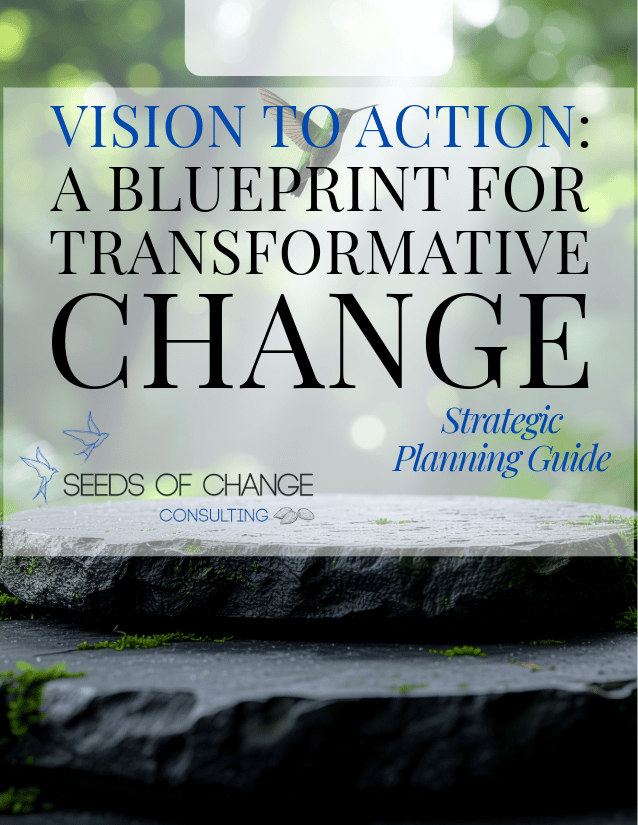 | What sets this guide apart is its refusal to treat strategic planning as a cold, corporate exercise. Unlike traditional toolkits that prioritize rigid growth metrics, the Vision to Action framework from Seeds of Change Consulting is built on the foundation of collective liberation and relational accountability. |







 | "In a racist society, it is not enough to be non-racist. We must be anti-racist."Angela Davis |
